Resilience Season
Avalanche Safety, Glacier-travel simulations, Ski Mountaineering · Community Traditions, Recovery methods, Onsen · Mt Yotei Summit · Climate impacts on Yukiguni
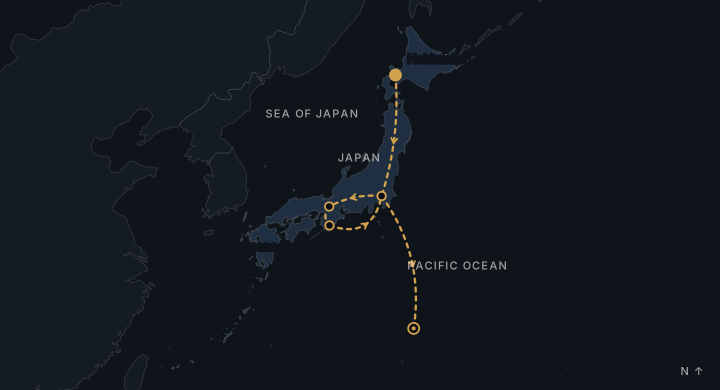
The Japan term opens in deep winter around Mt. Yotei, combining winter-mountaineering training with the study of impermanence and resilience. Guides teach avalanche safety, rope handling, simulated crevasse rescue and ski mountaineering. Local practitioners lead lessons on onsen traditions, seasonal livelihoods and disaster recovery; Ainu educators introduce distinct histories and approaches to land stewardship. The block extends the winter and cryosphere work begun in Yukon and the Khumbu towards Aconcagua and Denali, and examines how different philosophies and practices explain responses to change.
- What does resilience mean where communities have lived for generations with volcanoes, extreme snow and disaster? How do their accounts compare with “bounce-back” models of recovery?
- What might mono no aware and attention to seasonal change contribute to responses to climate change and uncertainty?
- How do onsen, recovery practices and seasonal rituals contribute to individual and collective resilience?
- How does Hokkaido’s winter affect my sense of impermanence, beauty and responsibility?
- Winter/early-spring immersion in Hokkaido's Yukiguni: avalanche safety, glacier-travel simulations and ski mountaineering in the volcanic landscapes around Mt. Yotei (Ezo Fuji).
- Onsen and recovery practice: practitioners teach hot-spring etiquette, rest, social life and seasonal routines. Scheduled sessions examine mutual aid and disaster recovery, including published and contributed accounts of the post-2011 period. Students work with the same guides and hosts across four weeks and join the seasonal activities included in the teaching program.
- Volcano research and crater exploration: volcanic geomorphology, geothermal features, crater ecosystems and the cultural and spiritual significance of volcanoes. Students contribute observations under the monitoring partner’s collection and reporting protocols.
- Climate impacts in snow country: changing snowpack, avalanche patterns, winter-tourism economies, and community adaptation.
- Seasonal awareness: forest therapy in snow and rituals through which to explore mono no aware and relationships with a winter landscape.
- Core inquiry: How do climate change, volcanic activity and community traditions interact to shape resilience in Hokkaido’s snow country? What can be learned from the relationships among infrastructure, traditional practice and philosophies of impermanence?
- Integrated volcano–climate research: geological observation, snowpack/avalanche monitoring, ecological survey in volcanic landscapes, and social-science inquiry into recovery and adaptation.
- Epistemology of resilience and impermanence: mono no aware, wabi-sabi and disaster memory alongside Western resilience theory and the accounts taught by Ainu educators.
- Community-based adaptation case studies: avalanche forecasting/education, onsen-based wellness, climate-resilient agriculture/tourism, volcanic-hazard preparedness — analysing effectiveness and equity.
- Extended Project integration: cryosphere/resilience-topic students gather winter field data.
- Operate safely in avalanche terrain (AIARE-equivalent): terrain recognition, stability assessment, companion rescue, and go/no-go decision-making (Judgement, Grit).
- Develop ski-mountaineering competence and practice glacier-travel technique through rope-handling and crevasse-rescue simulations on non-glaciated winter terrain (Grit, Judgement).
- Integrate volcano field methods and snowpack/climate observation into rigorous inquiry (Rigor, Awareness).
- Explore Japanese philosophies of impermanence, including mono no aware and wabi-sabi, alongside onsen and recovery culture (Awareness).
- Compare Japanese, Western and Ainu accounts of resilience and living with natural hazards, attending to variation within each (Rigor, Awareness).
Natural sciences. Volcanology; snow science & avalanche mechanics; the snowpack as climate signal.
Human sciences. Disaster memory and recovery institutions; rural depopulation; yukiguni traditions and the ski economy.
Epistemology. Impermanence (mujō) meets Western resilience theory; embodied knowledge — onsen and recovery culture.
Field Ledger. Snowpack decline entries (compared against Himalayan record).
Resource Atlas. Rural economies & ski tourism — Atlas case.
Ways of Knowing Journal. Japanese and Western accounts of resilience in structured dialogue.
- Winter mountaineering and avalanche safety (AIARE-equivalent): terrain and stability assessment, beacon/probe/shovel rescue, rope handling and crevasse-rescue simulations on non-glaciated snow terrain, ski-mountaineering technique, and decision frameworks in avalanche terrain.
- Volcano field methods: safe crater/geothermal exploration, basic gas/thermal monitoring, geomorphological mapping.
- Onsen and seasonal-living practice: cultural, therapeutic and social dimensions of recovery and rest.
- Cross-cultural research in Japan: basic Japanese for research contexts, cultural protocol, and rural-Hokkaido social navigation.
- Reflective and aesthetic practice: explore mono no aware through journaling, photography and artistic work.
| Week 35 Avalanche & Winter Skills | AIARE-level training | Avalanche terrain, stability tests, companion rescue drills; ski-mountaineering, rope handling and crevasse-rescue simulations on non-glaciated snow terrain; conservative decision frameworks. |
| Week 36 Volcano & Climate | Field methods, snowpack | Volcano/crater field methods; snowpack and climate observation; citizen-science contribution; begin integration with earlier cryosphere data. |
| Week 37 Onsen & Impermanence | Recovery culture, philosophy | Practitioner-led lessons on onsen and recovery; mono no aware and wabi-sabi study; teaching with Ainu educators; seasonal-awareness practice. |
| Week 38 Synthesis + Story | Photo essay/film, reflection | Comparative resilience synthesis; produce mono no aware photo essay + short film; personal reflection; prep for Honshu (Block 12). |
Primary (recommended). A photo essay exploring mono no aware (8–12 images), or haiku + visual narrative, paired with a short film on avalanche terrain, volcanic landscapes, onsen culture and community-recovery traditions in Yukiguni.
Alternatives (from menu). An account of an onsen-etiquette lesson with personal reflection; a climate-adaptation StoryMap or short documentary based on field evidence.
Narrative-craft guidance. What does resilience mean in places living with volcanoes and extreme snow? How can Japanese impermanence philosophy inform responses to climate uncertainty?
Competencies emphasised. Interpreting aesthetic and philosophical ideas through visual storytelling (Awareness, Rigor); reflecting on sustained winter-mountaineering effort (Grit); communication and collaboration with Japanese hosts (Impact).
Integration w/ Exploration & Research. Synthesises winter-mountaineering and avalanche training with volcano and climate research, cultural exchange and philosophical study.
Individually-accountable output. Extended Project winter cryosphere/resilience data; individual avalanche-decision reflection log (Judgement).
Team output. Volcano–climate dataset + community-adaptation case study.
Storytelling deliverable. Mono no aware photo essay/film on Craft axis; volcano/climate observation on Substance axis.
Primary competencies evidenced. Judgement, Grit and Awareness foregrounded; Rigor and Impact supporting.
Substance vs Craft. Field research counts as Substance, the aesthetic story as Craft; the two are scored independently.
Moderation. Avalanche skills assessed by certified providers; double-mark judgement observations; calibrate aesthetic work against anchors.
Teams frame volcano–climate questions and select a community-adaptation case. Four weeks of geological observation, snowpack monitoring, ecological survey and social inquiry produce a dataset and case study within the set training and fieldwork program.
Snowpack measurement and stability tests, basic gas and thermal monitoring at geothermal sites, geomorphological mapping, and winter cryosphere data logged for Extended Project work.
Practitioner-led teaching, published disaster-memory accounts and separately agreed research interviews inform recovery and adaptation case studies. Reflective journals distinguish these sources from students’ observations; instrumental and numerical records form the main field dataset.
Avalanche assessment, companion rescue, ski mountaineering, rope handling and simulated crevasse rescue are taught on non-glaciated Hokkaido snow terrain. Volcano and snowpack field methods are applied during winter excursions.
A photo essay exploring mono no aware through eight to twelve images, or haiku with visual narrative, paired with a short film on avalanche terrain, onsen culture and community recovery.
Students compare mono no aware, wabi-sabi, disaster memory and Ainu educators’ accounts with Western resilience theory, using reflective and aesthetic journals to examine their interpretations.
Local practitioners teach onsen etiquette, seasonal living and rural-Hokkaido protocols. Ainu educators lead sessions on their histories and land relationships. Basic Japanese and scheduled seasonal activities support participation across the four-week program.
The same guides and community teachers work with students across four weeks in scheduled sessions.
Companion rescue exercises, winter travel, snow and volcano fieldwork and the adaptation case require coordinated roles, shared records and mutual checks.
Group safety in avalanche terrain gives students supervised practice in partner checks, terrain assessment and conservative go/no-go decisions for the traveling party.
Teams select their adaptation case study and research domain and set daily observation routines, within a scheduled avalanche curriculum, fixed lodging and a faculty-set weekly arc.
Companion-rescue practice develops responsibility for a partner’s safety. Students record go/no-go reasoning, beacon checks and use of personal avalanche equipment in an individual decision-reflection log.
Four weeks of ski touring and ski mountaineering in Hokkaido snow country, carrying winter kit on ascents of Mt. Yotei and surrounding volcanic terrain, with onsen recovery between days.
Four weeks of Hokkaido winter: heavy snowfall, sub-zero days on exposed volcanic slopes, wind and avalanche-terrain cold, with onsen and indoor recovery at the end of each field day.
Six nights use winter camps or snow shelters during the skills and fieldwork phases. The remaining twenty-two nights use rural inns or other serviced accommodation.
No marine, coastal or freshwater-system content; the four weeks sit in interior volcanic snow country around Mt. Yotei.
Individual journals and aesthetic reflection accompany training and group fieldwork. No separate solo period is scheduled.
Winter excursions investigate volcanic terrain, geothermal features and snow conditions. Rope and rescue techniques are taught on snow-training slopes; community-adaptation visits connect the field records with local practice.
Volcanic geomorphology, geothermal features and crater ecosystems around Mt. Yotei with gas and thermal monitoring, alongside snowpack stratigraphy, avalanche science and climate observation.
Seasonal-awareness and forest-therapy practice in snow sits alongside snowpack and climate observation, community adaptation case studies, and analysis of climate-resilient agriculture, tourism and volcanic-hazard preparedness.
Disaster memory and recovery institutions in snow country, different accounts of living with natural hazards, and the social history of onsen and mutual aid, taught through readings and practitioner-led sessions.
Community-adaptation cases consider the distribution of vulnerability and recovery support. Equity is a component of the case analysis rather than a separate sustained inquiry.
Winter-tourism economies under changing snowpack, climate-resilient agriculture and tourism, and the funding of avalanche forecasting and hazard preparedness are covered within the adaptation case studies.
Mono no aware, wabi-sabi, disaster memory and Ainu educators’ teachings are considered alongside Western resilience theory. Onsen lessons and seasonal-awareness practice connect these discussions with winter experience.