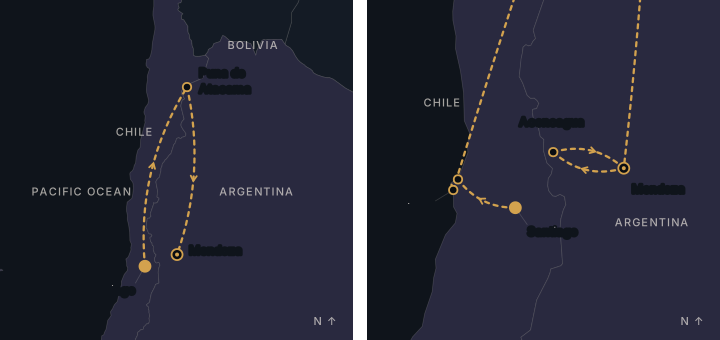
Foundations: Identity, History & Orientation (Chile)
Chilean national identity & memory; colonial legacies & independence; modern political economy & stability model; Pacific orientation; Coastal Pacific identity & marine environments
Following the university-admissions period, this block introduces Chilean identity, memory and political economy before the Andean altitude progression. Pacific and Humboldt Current studies connect national questions to coastal experience, while freediving at Quintay resumes the program’s marine skills and exploration of relationships with the ocean. The block establishes the comparative Chile–Argentina inquiry into stability and resource economies that develops through the term’s capstone.
- How does Chile's Pacific-facing geography shape its geopolitics and trade relationships compared with Atlantic-oriented neighbors?
- How do sites of memory (e.g., the Museum of Memory) reveal ongoing negotiations of democracy and human rights?
- What economic and social trade-offs are visible in Santiago's urban landscape and Valparaíso's port history?
- What tensions exist between historical whaling/port industries and contemporary marine conservation, and how do direct ocean experiences reveal personal/cultural relationships to the sea?
- Santiago's historic center and markets; Valparaíso's UNESCO street art, funiculars, port history and Neruda's La Sebastiana; Museum of Memory & Human Rights and the Pre-Columbian Art Museum.
- Coastal Pacific identity: freediving and snorkelling in Quintay's sheltered cove and nearby sites (wrecks, rocky reefs, marine life), and a visit to the historic whaling-station museum and current fishing-port infrastructure.
- Chilean political economy in the landscape: copper nationalisation history, post-Pinochet reforms, current lithium strategy, urban inequality, and Indigenous rights movements.
- The Humboldt Current and port economies connect marine productivity, trade, coastal livelihoods, conservation and Pacific identity.
- Pre-arrival readings + on-site analysis of copper nationalisation, post-Pinochet economic reform, lithium strategy and trade data; comparative GDP-stability charts vs Argentina.
- Practitioner-led urban-history and policy visits, with separately agreed interviews on inequality and Indigenous rights; nightly journals connect observations with the historical and economic sources.
- Coastal comparison: fishers and heritage practitioners teach about Quintay’s port, working waters and changing livelihoods. Students compare these lessons with Santiago’s urban economy and with the history of whaling and marine conservation.
- Epistemology: how sites of memory reveal contested national narratives; how the Humboldt Current shapes identity and economy.
- Extended Project integration: near-final Extended Project consolidation; identity/political-economy topics gather data.
- Analyse Chilean national identity, memory and political economy (copper, lithium, post-Pinochet reforms) with historical depth (Rigor, Awareness).
- Compare Chile's Pacific orientation and stability model with Argentina's, seeding the term's comparative inquiry (Rigor, Judgement).
- Engage sites of memory and human rights critically, understanding democracy as ongoing negotiation (Awareness, Judgement).
- Reconnect marine skills via Quintay freediving and analyse whaling-to-conservation transition and human–ocean relationships (Grit, Awareness).
- Adapt to a new culture and language, building Spanish survival competence and positionality awareness (Impact, Awareness).
Natural sciences. The Humboldt Current: upwelling, marine productivity, coastal climate.
Human sciences. Chile's political economy: copper nationalisation, the Chicago Boys, the stability model; memory and dictatorship.
Epistemology. National memory as contested knowledge — museums, monuments and archives as evidence.
Field Ledger. Coastal climate & fisheries under change.
Resource Atlas. COPPER — the Atlas master case begins.
Ways of Knowing Journal. Whose account of 1973–1990 gets institutionalised, and how would we know?
- Structured walking seminars and debriefs; field note-taking and photo documentation.
- Group norm-setting and leadership-rotation exercises re-established for a new term/context.
- Basic Spanish survival phrases and cultural-etiquette practice.
- Reflective journaling on adaptation, positionality and cultural transition.
- Freediving and marine-observation skills refreshed for the coastal module.
| Days 1–5 Santiago + Memory | Identity, political economy, human rights | Santiago immersion; Museum of Memory and Pre-Columbian Museum; copper/lithium/political-economy analysis; Spanish and etiquette basics; team norm-setting. |
| Days 6–10 Coast + Freedive | Valparaíso, Quintay, ocean identity | Guided study of Valparaíso’s port and art history; Quintay freediving; teaching with fishing and whaling-heritage practitioners; coastal and urban comparative observations. |
| Days 11–14 Synthesis + Story | Photo essay / freedive narrative | Comparative synthesis (Chile identity/economy); produce photo essay or freediving narrative; Extended Project consolidation; prep for high-altitude progression. |
Primary (recommended). Valparaíso and Quintay photo essay or freediving narrative (underwater observations + port/whaling history) linking personal embodied adaptation and ocean relationship to Chilean Pacific identity, colonial legacies, memory, and marine-conservation tensions.
Alternatives (from menu). Port/whaling-to-conservation historical comic or zine; urban–coastal comparative StoryMap with narrative.
Narrative-craft guidance. How do history and geography shape national identity and economic choices in Chile? What tensions exist between whaling/port industries and marine conservation?
Competencies emphasised. Place-based identity and memory storytelling (Awareness, Rigor); freediving and marine-observation narrative (Grit, Audacity); national-narrative synthesis (Impact).
Integration w/ Exploration & Research. Grounds Foundations: Identity, History & Orientation (Chile) exploration (urban immersion, coastal module, freediving) in historical and political-economy research; opens the term's comparative inquiry.
Individually-accountable output. Near-final Extended Project consolidation; individual comparative political-economy/identity analysis; reflective log.
Team output. Comparative Chile political-economy/identity briefing.
Storytelling deliverable. Photo essay / freedive narrative on Craft axis; political-economy analysis on Substance axis.
Primary competencies evidenced. Awareness and Rigor foregrounded; Judgement, Grit and Impact supporting.
Substance vs Craft. Political-economy/identity analysis counts as Substance, the narrative as Craft; the two are scored independently.
Moderation. Calibrate identity/memory storytelling against anchors; double-mark political-economy analysis.
Set readings and comparative questions guide analysis of copper, reform, lithium and national history. Students prepare a political-economy briefing while consolidating independently selected evidence and arguments for their Extended Projects.
Trade data, inflation figures and comparative GDP-stability charts against Argentina carry the numerical work, with structured field records from the coastal module. No instrumentation or systematic sampling.
Museums, monuments and port architecture are examined as historical evidence, alongside guided interpretation and separately agreed interviews on urban inequality and Indigenous rights. Students distinguish sources from personal reflections in their journals.
Students refresh freediving safety, breath-hold fundamentals and buddy procedures for the Quintay module, while practicing field notes, photography and Spanish in urban and coastal work.
A Valparaíso and Quintay photo essay or freediving narrative, with a port-and-whaling historical comic or zine and an urban–coastal StoryMap as alternatives, supported by field photo documentation.
Sites of memory are read as contested national narrative, positionality awareness is built through cultural and language transition, and nightly journal prompts tie personal observation to national themes.
Local teachers and guides introduce the histories and visitor protocols of Santiago, Valparaíso, Viña del Mar and Quintay. Foundational Spanish, field visits and reflective writing support participation in the urban and coastal program.
Fishers, heritage practitioners and urban guides lead scheduled teaching on work, history and land and water use.
Group norm-setting and leadership-rotation exercises are re-established for the new term, and a comparative political-economy briefing is a team output.
Students establish group norms and practice rotating coordination roles at the start of the term. Faculty set the overall itinerary and daily program.
The itinerary, sites and framing questions are faculty-set. Students choose their storytelling medium, the direction of their Extended Project and how the comparative analysis is argued.
Students manage personal preparation, cultural and professional conduct, freediving buddy procedures, research records and individual submissions during the urban and coastal program.
Two weeks of walking seminars through Santiago's historic center and markets, Valparaíso's hill quarters and port, and shoreline sites, with breath-hold swimming at Quintay. No loads and no ascent.
The urban program is combined with a coastal and freediving module at Valparaíso–Quintay, introducing direct exposure to coastal weather and cold water during part of the fortnight.
Accommodation is urban and coastal throughout, in Santiago, Valparaíso and Quintay, on mains power, water and sanitation. No camp craft and no self-supported living systems are practiced.
Days 6–10 provide the Valparaíso–Quintay coastal module, including freediving and marine field observation. The rest of the fortnight centers on urban and historical investigation.
The cohort moves together through cities, coast and dive sessions, and apart from individual journaling at night, no solo, sit-spot or silent practice is scheduled.
Walking seminars investigate Santiago, Valparaíso’s funiculars, street art and port, La Sebastiana, and Quintay’s cove and whaling-station museum. Fishing practitioners explain the working port and use of coastal waters.
The Humboldt Current and coastal upwelling frame marine-ecosystem observation on Quintay's rocky reefs and wreck sites during freediving and snorkelling. Terrestrial ecology sits outside the fortnight.
Students compare Quintay’s whaling history and marine conservation with sustainability and equity questions in Chile’s development model, using the Humboldt Current as the coastal systems case.
Chilean identity and memory through the Museum of Memory & Human Rights and the Pre-Columbian Art Museum, Valparaíso's port and UNESCO quarters, Neruda's La Sebastiana, and colonial legacies and independence.
Sites of memory and human rights are read as contested national narrative, alongside urban inequality, Indigenous rights movements and the distributional costs of the post-1973 reforms.
Privatisation, deregulation and pension overhaul under the Chicago Boys, hyperinflation stabilisation, the copper nationalisation legacy, lithium strategy and trade data, with GDP-stability charts set against Argentina.
Sites of memory, museums and port histories are examined as competing accounts of national identity. The Ways of Knowing Journal identifies assumptions in historical interpretation, resource development and the student’s own observations.